Markets · Explainer
The 2007 Merger That Created Emirates NBD
On a single October trading day, two listed Dubai banks made way for one stock.

Kunkafa News · Published · 3 min read
 By Kareem FaridDiscuss with the author on X
Here is a visual story in summary
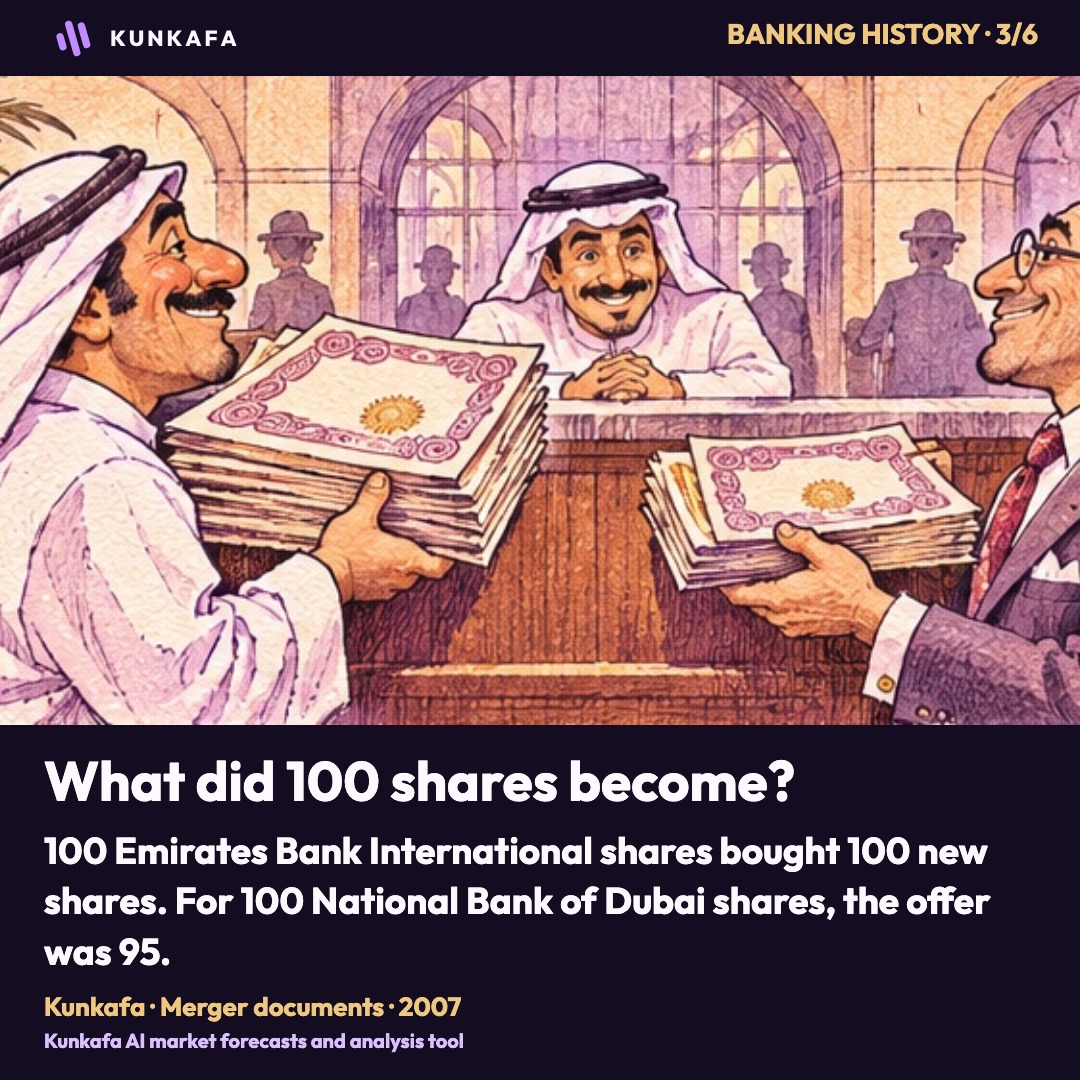
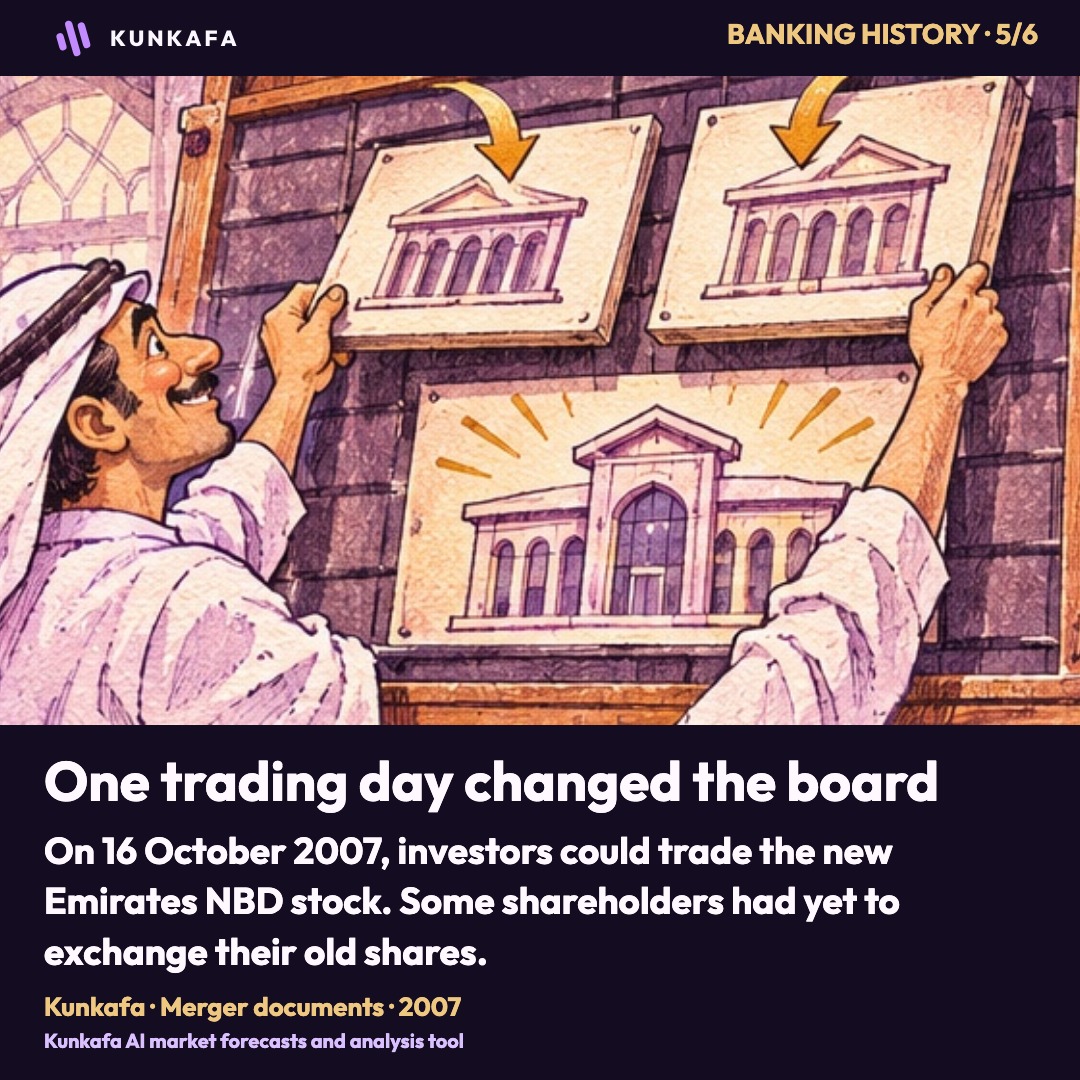
On 16 October 2007, Dubai Financial Market delisted Emirates Bank International and National Bank of Dubai and listed Emirates NBD. Investors who owned a hundred shares on the eve of the exchange could come away with either 100 or 95 shares in the new company. The determining fact was which of the two old banks they owned. [2]
Key points
- The banks presented 2006 assets of roughly AED96 billion and AED69 billion.
- Both became wholly owned subsidiaries by the end of 2007.
What Dubai put together
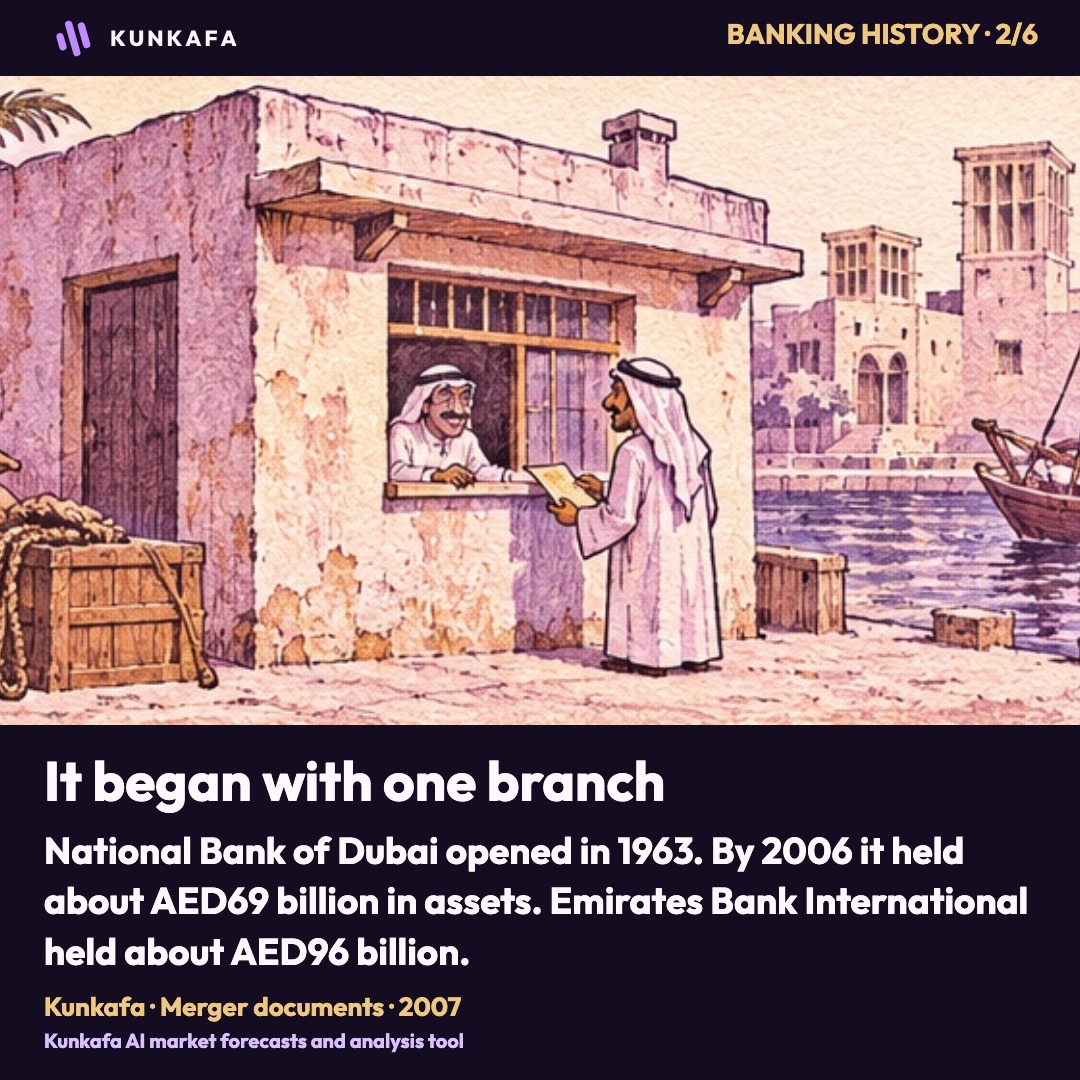
National Bank of Dubai traced its roots to a single branch in 1963. Four decades later its assets stood at about AED69 billion against Emirates Bank International’s AED96 billion, according to the July merger presentation using 2006 accounts. Together the two had AED165.2 billion of assets, AED109.1 billion of customer loans and AED95.3 billion of deposits. These were historical combined figures used to pitch the deal. [1] [3]
The presentation showed the two already had complementary reach: together they accounted for about a fifth of UAE corporate lending and nearly a quarter of personal loans in its 2006 comparison. That distribution footprint offered a wider customer base for each bank’s products. Turning it into a single business still required an exchange of ownership. [1]
The Capsule
- July 2007 sets the offer terms and incorporation of the new company.
- One EBI share exchanged for one new share.
- One NBD share exchanged for 0.95 new shares.
- 16 October marks the switch on Dubai Financial Market.
A share exchange rather than a cash exit
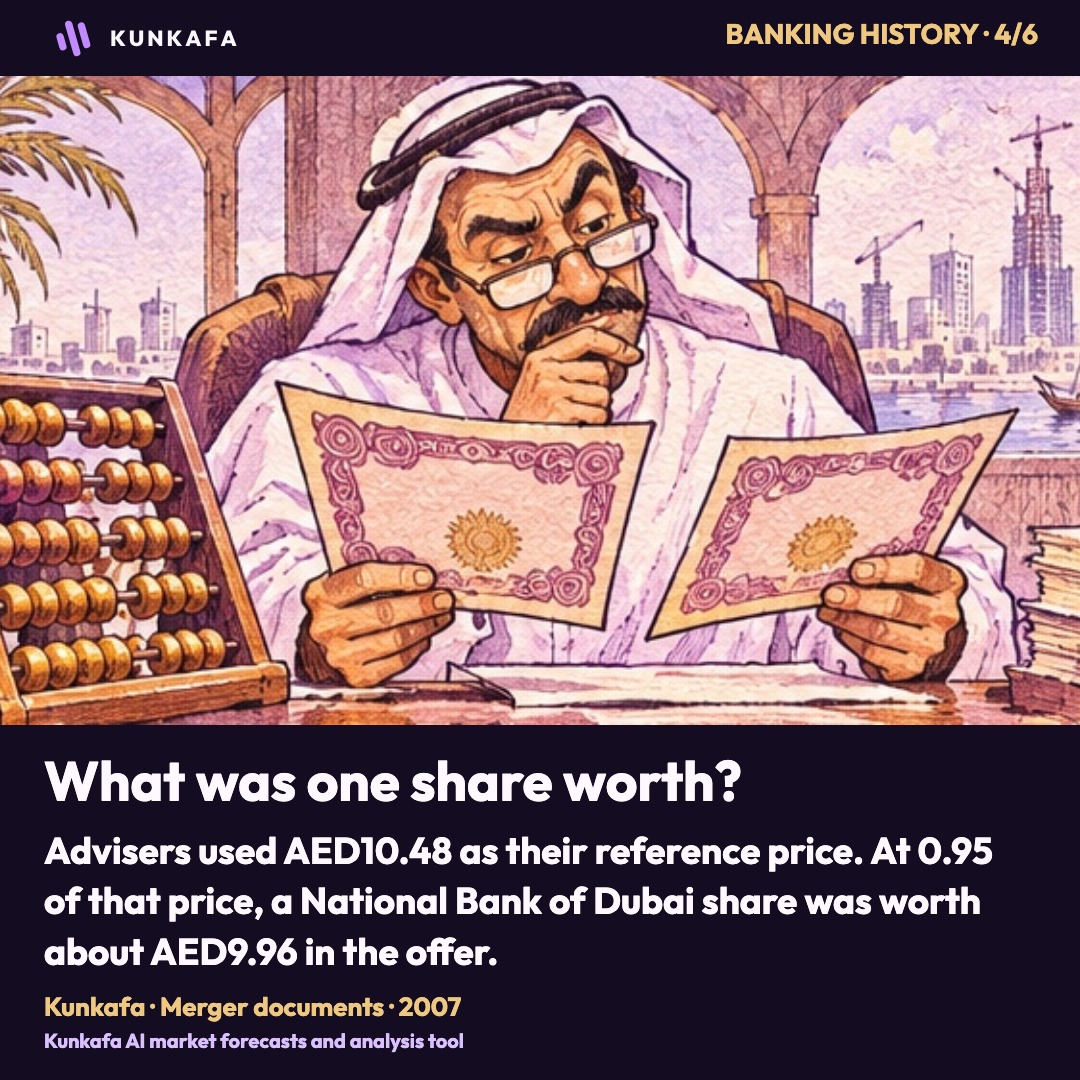
The groups used a newly incorporated public company to buy both banks with shares. At the AED10.48 Emirates Bank price the advisers used from 5 March, multiplying by 0.95 implied AED9.96 per National Bank of Dubai share after rounding. That was a reference valuation. A participating holder received an ownership interest whose market price could change. [1] [2]
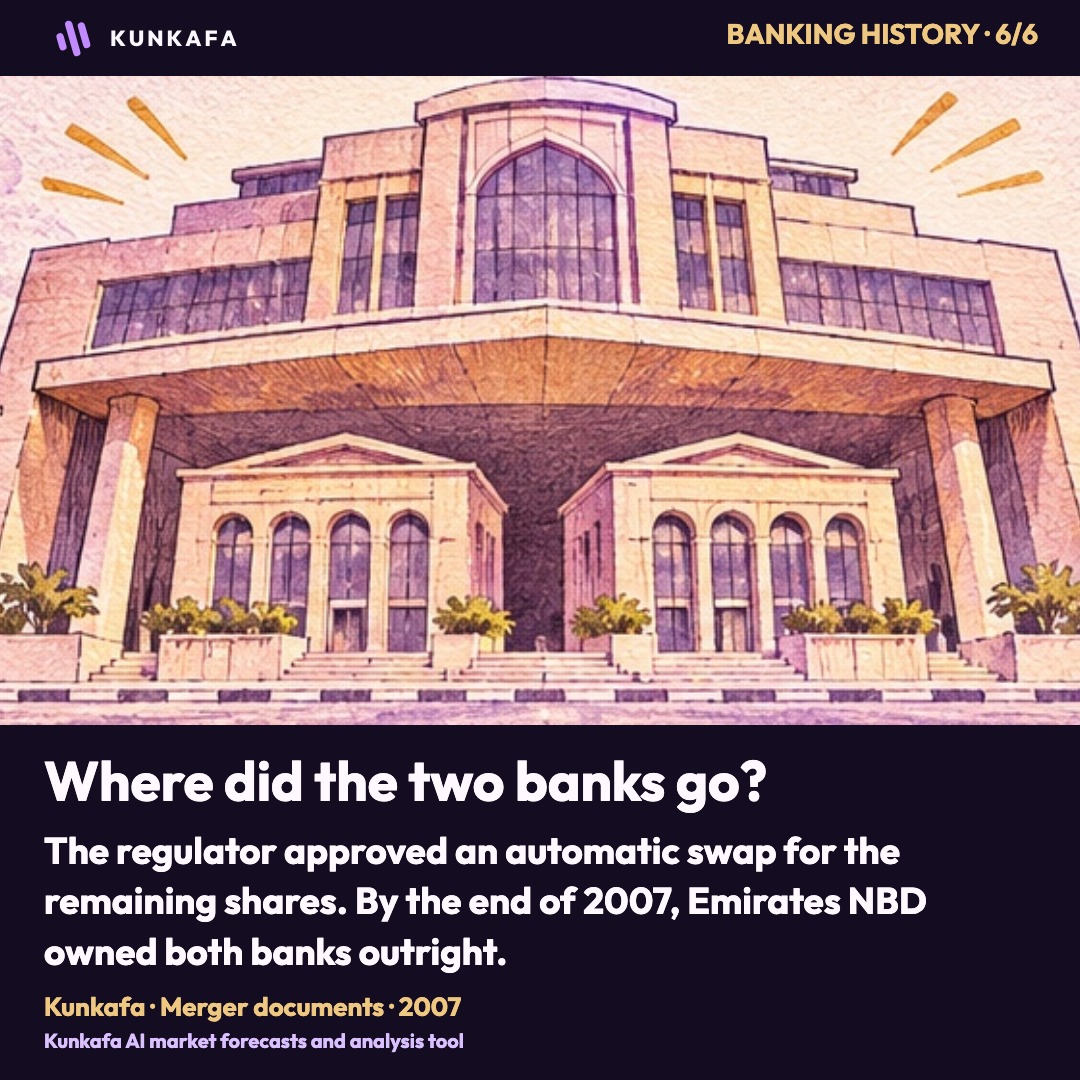
At completion, 99.11% of Emirates Bank International and 97.63% of National Bank of Dubai shareholders had exchanged their holdings, the group later reported. The regulator subsequently approved automatic exchange for the remaining non-respondents. By year-end, both former listed banks sat under the new parent. That sequence explains how Emirates NBD could already trade while the final transfers were still being completed. [2]
Sources: [1] Joint merger presentation, 12 July 2007 · [2] Emirates NBD accounts, 2008, note 12 · [3] Emirates NBD, history of its first branch
Kunkafa forecasts
Euro - Dollar
How far it could move, which way, by when, and how confident Kunkafa is.
Check the latest forecastsMore in Markets

How Much Interest Does a $1,000 US Treasury Bill Pay?
In one US auction, a buyer paid $988.78 for a bill worth $1,000 at maturity. Here’s how to turn an auction price into dollars of interest.

Why a Call Option Can Lose Money When the Stock Rises
A buyer can call the direction of an earnings move correctly and still lose $200 on a standard contract when the event premium falls.

Cboe Lets You Bet on Nvidia’s Sales Even if Its Stock Falls
New $1-or-$0 contracts cover more than 100 company metrics, including Amazon’s cloud sales and Tesla’s car production. Robinhood is rolling them out first.