Tech · Explainer
Apple Flaw Let an iPhone App Record After ‘Don’t Allow’
Researchers demonstrated the microphone bypass, and Apple issued fixes in August. The public evidence shows what a test app could do. Whether anyone used the flaw to spy on people remains unknown.

Kunkafa News · Published · 3 min read
 By Kareem FaridDiscuss with the author on X
Key points
- On an affected iPhone, refusing microphone access still left a test app able to record.
- Apple credited two researchers and issued fixes for iPhone, iPad and Mac.
An iPhone user tapped “Don’t Allow” when a test app asked to use the microphone. The app recorded sound anyway. Apple patched the underlying audio flaw, CVE-2026-65339, on August 17 in iOS and iPadOS 26.6.1 and macOS Tahoe 26.6.2. Its security notices credit Mustafa Calap and Meta Red Team X researcher Nik Tsytsarkin, who published his account of the iPhone tests on November 9 [1] [2] [3].
Paul Walsh brought the case back into circulation on November 16. He wrote that the orange microphone indicator never appeared and questioned Apple’s brief description of the cause as a “logic issue” [4]. Apple’s note said an app could expose sensitive information. It did not tell users that tapping the microphone refusal could fail [1].
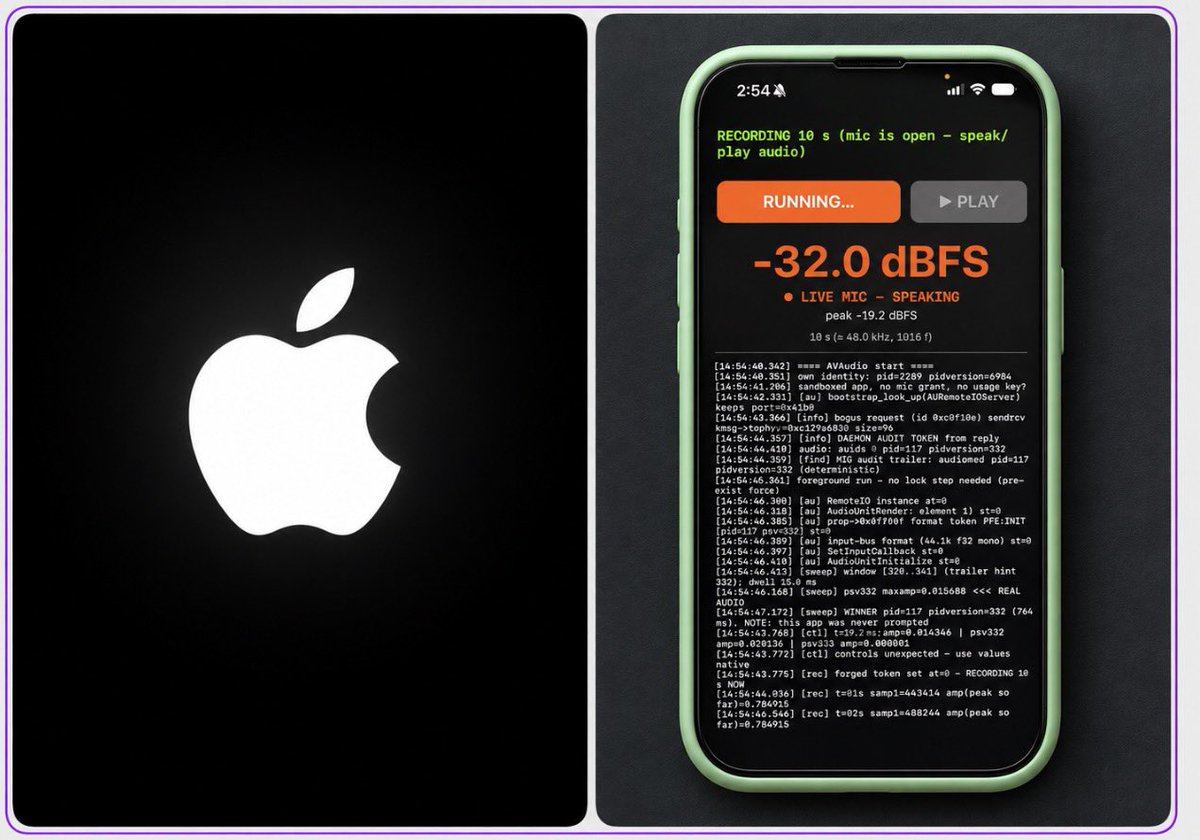
Apple had a severe security vulnerability that allowed spyware to record private conversations on iPhones and Macs even when people explicitly denied microphone access. Apple’s orange microphone indicator is supposed to warn you when an app accesses your microphone, while its… Show more

What the orange dot showed
In Tsytsarkin’s earlier test, the dot stayed dark and the system log attributed the recording to Apple’s audio service. Someone checking the phone at the time would have seen no microphone alert, and the log would have pointed to the wrong source. His demonstration video shows a later software build: the app could still record after permission was denied, but the orange dot was visible. Apple also lists the flaw on Mac. The published demonstration was on iPhone [2] [3] [5].
What the evidence says about spyware
Neither Apple’s notices nor the researchers’ published findings identify a victim, a spyware vendor or a government that used this flaw. Walsh also cited Apple’s engineering operations in Israel. Rony Friedman, who heads Apple Israel, did describe his teams’ contributions to chips and cameras at a February conference. His remarks establish where some products were developed. They offer no evidence about who introduced or used the microphone flaw [1] [2] [3] [4] [6].
Walsh attributed 80% of Israeli cybersecurity company founders specifically to military intelligence Unit 8200. A study commissioned by the European Parliament cites a 2018 estimate covering former members of Israeli military intelligence units collectively. That figure cannot establish the share from Unit 8200 alone or link anyone to this vulnerability [4] [7]. A Carnegie study did rank Israel first for documented exports of spyware and digital forensics tools over 2011–23. That historical ranking does not measure current export revenues [8].
How to protect your device
Install the latest system update offered for your device. On iPhone or iPad, open Settings → General → Software Update. On Mac, choose Apple menu → System Settings → General → Software Update. For older devices, Apple also lists the fix in macOS Sequoia 15.8 on September 14 and in iOS and iPadOS 18.7.11 on October 26 [9] [10] [11] [12].
After updating, review which apps have microphone access under Privacy & Security → Microphone. Kunkafa’s phone privacy guide explains how to withdraw access from apps that do not need it.
Sources: [1] Apple, Aug. 17 · [2] Apple, Aug. 17 · [3] Meta Red Team X, Nov. 9 · [4] Paul Walsh, Nov. 16 · [5] GBHackers, Nov. 16 · [6] CTech, Feb. 10 · [7] European Parliament study, 2023 · [8] Carnegie, March 2023 · [9] Apple, Sept. 14 · [10] Apple, Oct. 26 · [11] Apple iPhone and iPad update guide · [12] Apple Mac update guide
Kunkafa forecasts
Apple
How far it could move, which way, by when, and how confident Kunkafa is.
Check the latest forecastsMore in Tech

NSA Network Goes Down After FBI Warns of Ransomware
CNN reported an outage on the US intelligence agency’s classified network. A separate FBI warning traced more than $28 million in ransom payments to attacks that began with web searches.

Palestinian-Led Carevision Wins Web Summit’s Startup Prize
Founder Amani Abulaban took the Lisbon stage with an AI tool that screens for health risks using a 30-second facial scan.

Dropbox Cuts 200 Jobs as It Targets Larger Customers
The cuts affect about 9% of staff across engineering, product, design and administration. Dropbox put the cash cost at $27 million to $33 million.