Tech · Explainer
OpenAI’s Protein Designs Hit All Five Targets in Lab Tests
Of 322 proteins tested by Onava, 35 attached to their intended targets. Specialist models helped choose which GPT-6.2 designs reached the lab.

Kunkafa News · Published · 4 min read
 By Kareem FaridDiscuss with the author on X
Here is a visual story in summary
A protein shape imagined by a chatbot faces a test no chatbot can grade. Once made, does the molecule attach where it should? OpenAI and its research partner Onava report that 35 of 322 small proteins based on GPT-6.2 designs did. The hits spanned all five targets in their experiment. [1]
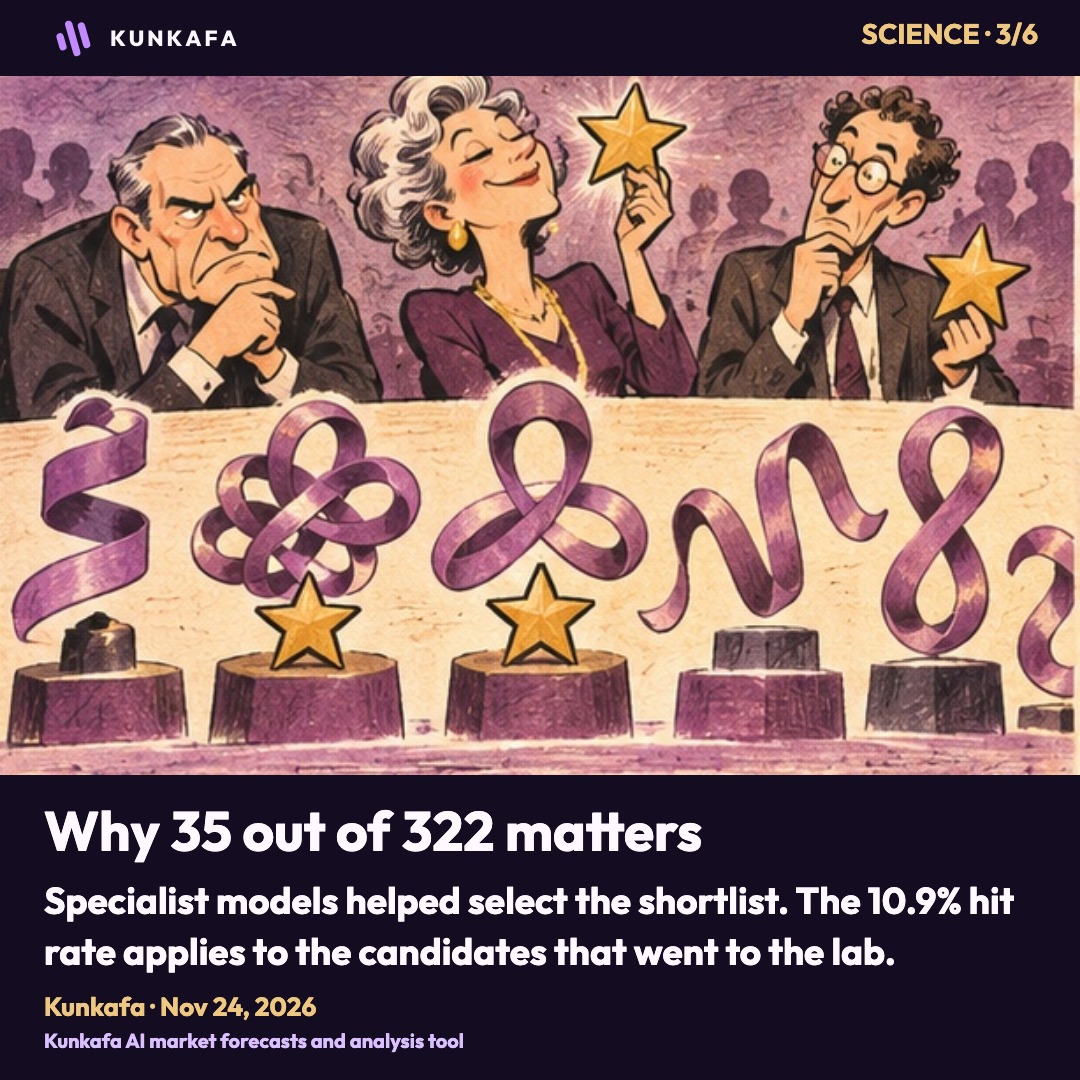
That puts the hit rate at 10.9% among the candidates selected for the lab. The November 24 preprint measures a physical property, binding. It leaves open the much harder question of whether any candidate could safely treat a disease. [1]
Scientists design proteins to develop new biotechnologies and potential medicines. The challenge is turning a goal, such as blocking a signal involved in disease, into a protein with the shape and sequence needed to do that job. This often takes many specialized models, each… pic.twitter.com/4lBUVF5o3R
What a scientist can ask in ordinary language
A researcher may know the job a protein needs to do long before anyone knows its shape. OpenAI sees an advantage in letting the scientist describe that job in words and change the request as new evidence comes in. Specialized software typically accepts a narrower set of instructions. [2]
The distinction matters when reading the lab result. GPT-6.2 proposed the shapes. Specialist models helped supply the sequences and decide which candidates reached Onava’s bench. The 10.9% figure describes that shortlist. [1]
Designing a shape and predicting one are different skills
The 2024 chemistry Nobel captured the difference. David Baker won half for designing proteins on a computer. Demis Hassabis and John Jumper shared the other half for predicting the structures of proteins. One question starts with what you want to build. The other starts with a protein whose shape you want to understand. [3]
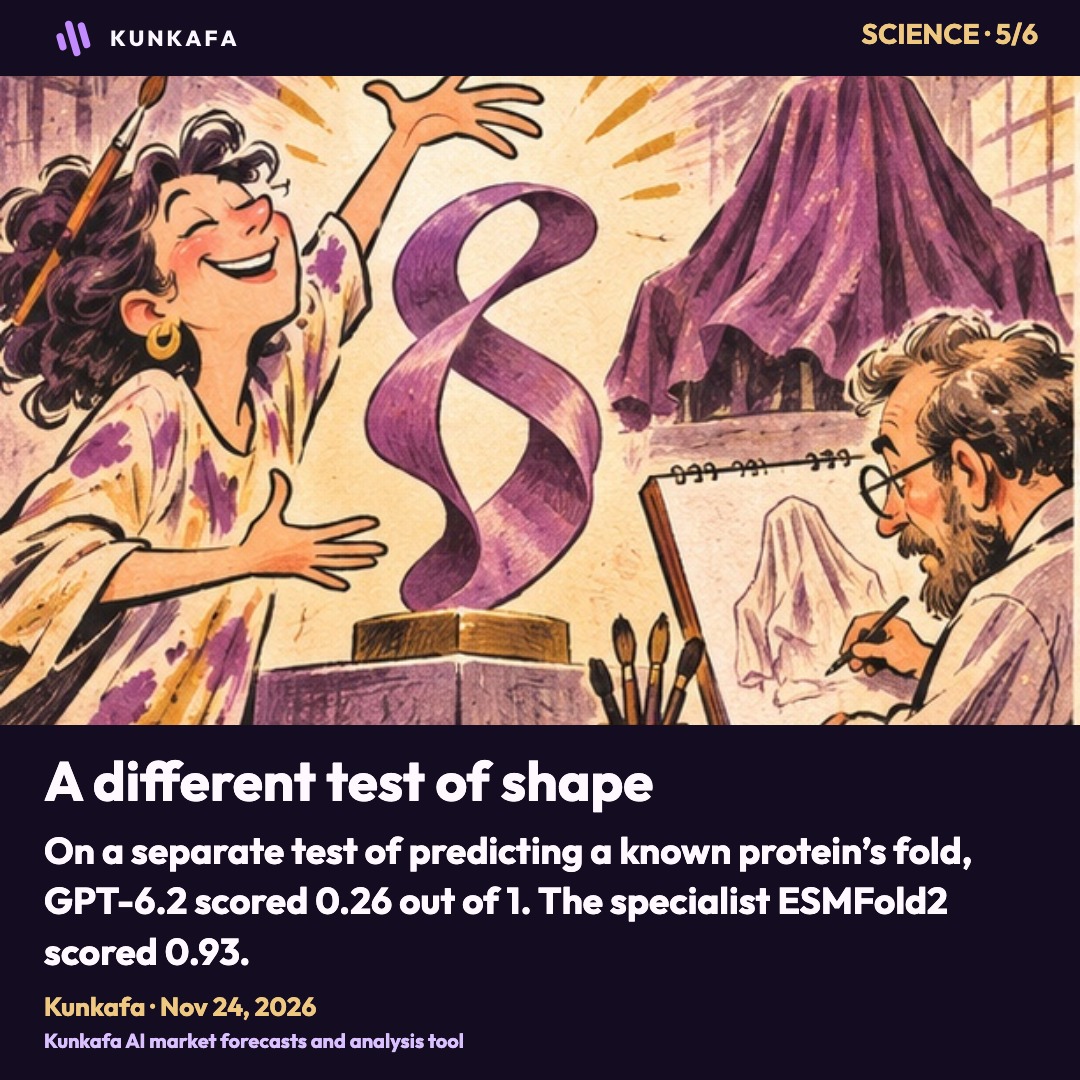
Predicting the entire fold remains a weakness for OpenAI. On a scale where 1 is a perfect match to the measured structure, GPT-6.2 averaged 0.26. A newer internal OpenAI model reached 0.38. The specialist ESMFold2 scored 0.93. For researchers choosing a tool, the question is still which part of the job they need it to do. [1]
For Tom Mullins, the experiment mattered because someone had put GPT-6.2’s predictions to a physical test. Engineer Max Petrusenko wanted a clearer accounting of what held up in the lab. Niki Georgiev asked how the work might benefit people. Daniel Nkencho welcomed the prospect of another AI company joining Google in scientific research.
Perspectives on AI-designed proteins


Sources · [1] OpenAI’s laboratory results · [2] OpenAI’s announcement · [3] Royal Swedish Academy of Sciences
Kunkafa forecasts
Nasdaq 100
How far it could move, which way, by when, and how confident Kunkafa is.
Check the latest forecastsMore in Tech

Amateur Astronomer Flags 49 Possible Planets With AI
Ethan Byrd searched observations of 19 million stars with OpenAI’s Astra. One candidate is awaiting review by researchers on NASA’s TESS mission.

Hack Exposed Unclassified CIA and ODNI Data, NYT Reports
The CIA and the US intelligence chief’s office discovered the breach. Even when a source is public, the questions an analyst asks of it can be sensitive.

Argmax’s Offline Voice AI Hits 100M Monthly File Requests
In May, WhisperKit crossed 10 million monthly requests on Hugging Face. Its appeal is easy to hear in a quiet interview room. A phone can turn the conversation into text without sending the recording away.