Tech · Explainer
Google’s Willow Wins 98.3% of Rounds, Beating an 88.9% Classical Limit
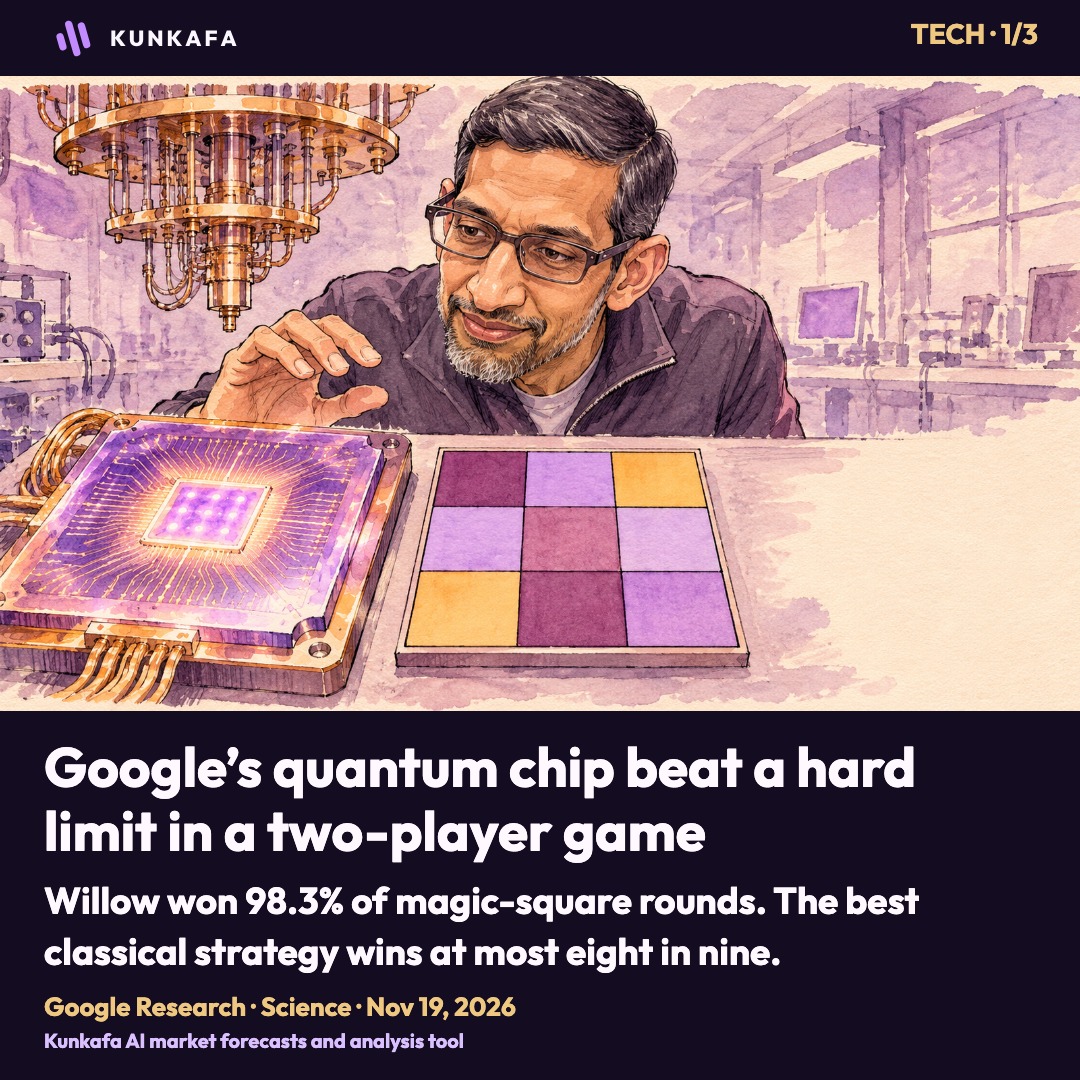
Google’s quantum chip beat the best classical strategy in a two-player puzzle. The same physics gave engineers a way to spot errors on the chip.

Kunkafa News · Published · 3 min read
 By Kareem FaridDiscuss with the author on X
Here is a visual story in summary
Key points
- Willow beat the best classical strategy by 9.4 percentage points in the two-player magic square game.
- The experiments exposed hardware errors that other tests can miss. One task scaled to 105 qubits.
Give two players a three-by-three grid and forbid them to talk. Even if they agree on a strategy beforehand, they can win the magic square game at most eight times in nine. Google CEO Sundar Pichai said on November 19 that Willow, the company’s quantum processor, won 98.3% of rounds. The team published the experiments in Science. [1] [2]
Entanglement usually gets top billing in quantum computing, but quantum contextuality, the idea that properties don't have fixed values independent of how you measure them, may be the deeper reason quantum computers can outperform classical ones. Today on the cover of…
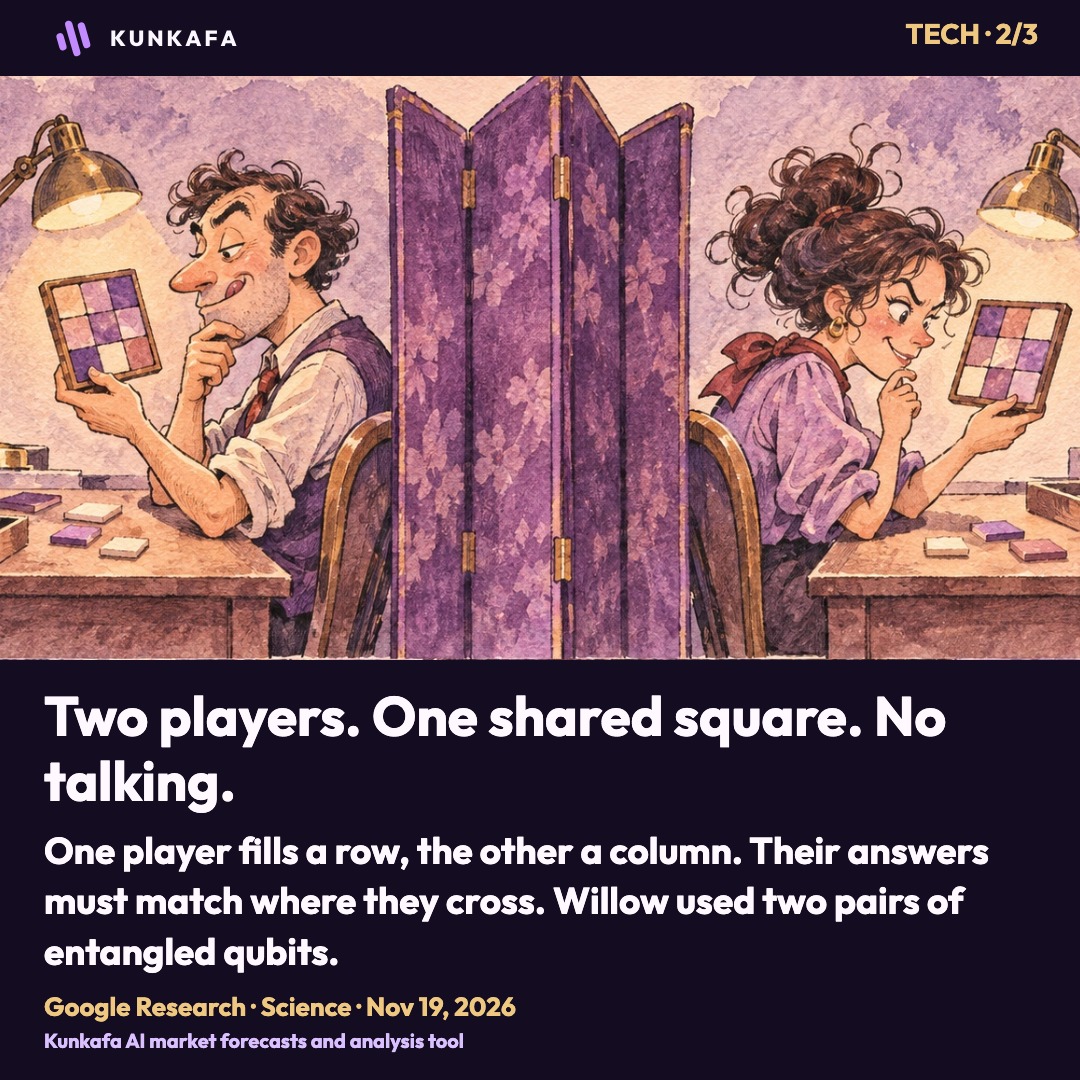
Each round, one player fills a row and the other a column with +1 or −1. The row must multiply to +1, the column to −1, and their entries must agree where the two cross. A grid fixed in advance cannot meet all three conditions across all nine pairings. On Willow, the players shared two pairs of entangled qubits. Each player’s choice of measurements depended on the row or column received. Google ran each of the nine pairings 100,000 times. [3]
The feature under test is called contextuality. A quantum measurement can yield a result that depends on which other compatible measurements are made alongside it. In a separate test that works regardless of the initial quantum state, the team scored 5.59. Preassigned values allow at most 4, while quantum theory permits 6. [2] [3]
The group then beat classical strategies in a multiplayer game with up to 71 qubits. A different task used up to 105 qubits to find a hidden mathematical relationship using a fixed number of layers of operations. That limit on circuit depth matters because a classical circuit given more layers can pass information farther. The experiments establish an advantage under specific rules. [3]
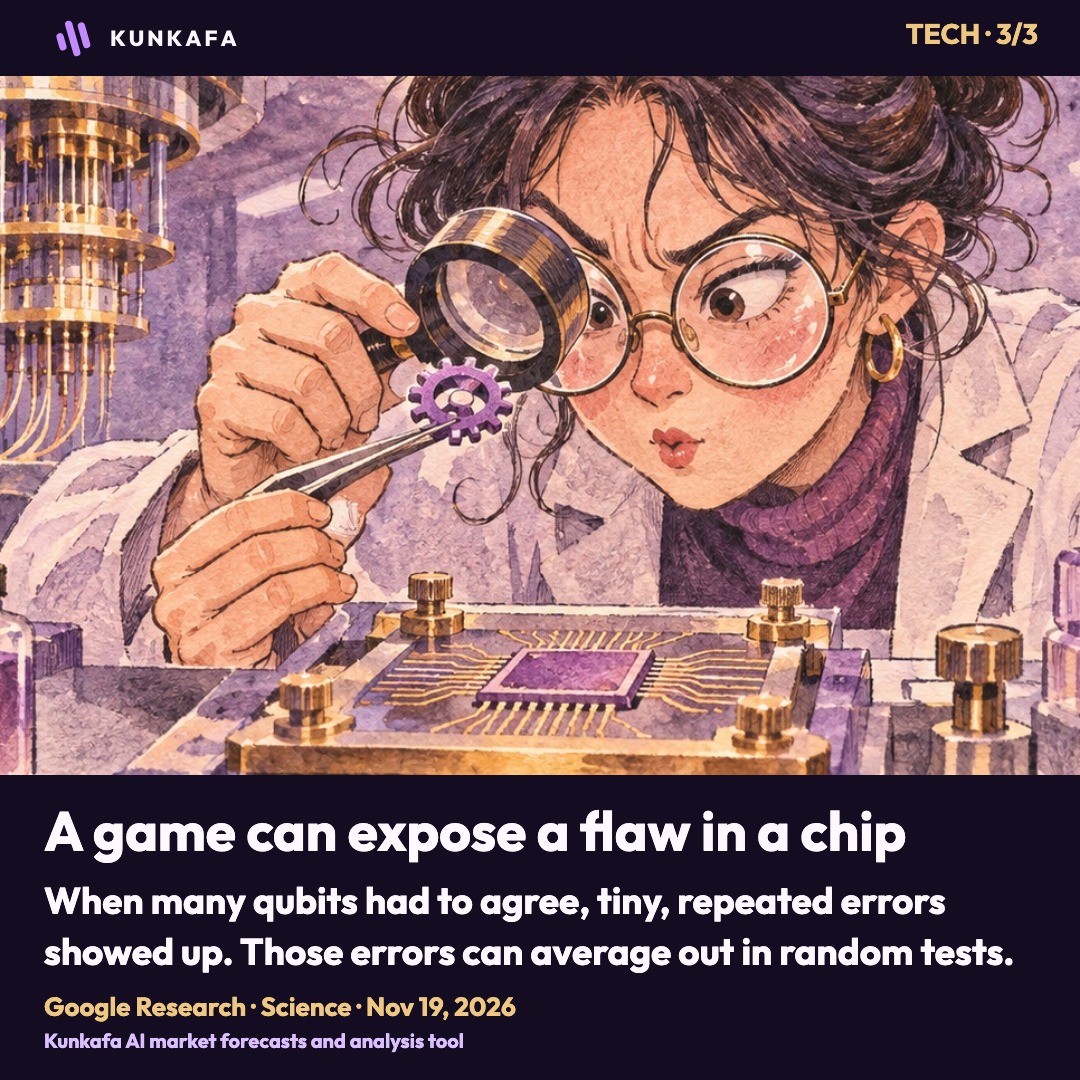
For engineers the immediate payoff is a hardware test. Getting many qubits to agree exposed small, systematic rotations away from their intended states. In random test circuits those errors can average out. A processor that scores closer to the quantum ceiling gives engineers a way to track whether their fixes are working. [3]
Jules Solopreneur marveled at the gap between the two kinds of machines. A developer posting as Solo Dev asked what the experiment might change about the way quantum algorithms are designed.
Perspectives on Google’s quantum experiment


Sources: [1] Sundar Pichai · [2] Science · [3] Google Research · [4] Solo Dev · [5] Jules Solopreneur
Kunkafa forecasts
Alphabet
How far it could move, which way, by when, and how confident Kunkafa is.
Check the latest forecastsMore in Tech

Hackers Leak Customer Data Tied to Visa, Mastercard and Chase
Mastercard says emails from a benefits program were exposed. Visa says its systems were unaffected and it has seen no sign that card numbers were compromised.

OrcaRouter’s Shield Fooled an AI Hacker for a Minute in a Test
OrcaRouter says its new Shield tool had already spotted ARTEX by the time the agent recognized the decoy in a test on the company’s own site.

PHP Can’t Catch a Break: Seven New Critical Flaws
Patches are out for four PHP branches, a month after attackers exploited the October flaws. Here’s which version your site needs.