Markets · Q&A
Can a Covered Call Cost You a Stock Dividend?
A shareholder can lose an upcoming dividend if an American-style call is exercised early. The timing of exercise can matter more than the notification.

Kunkafa News · Published · 3 min read
 By Kareem FaridDiscuss with the author on X
Here is a visual story in summary



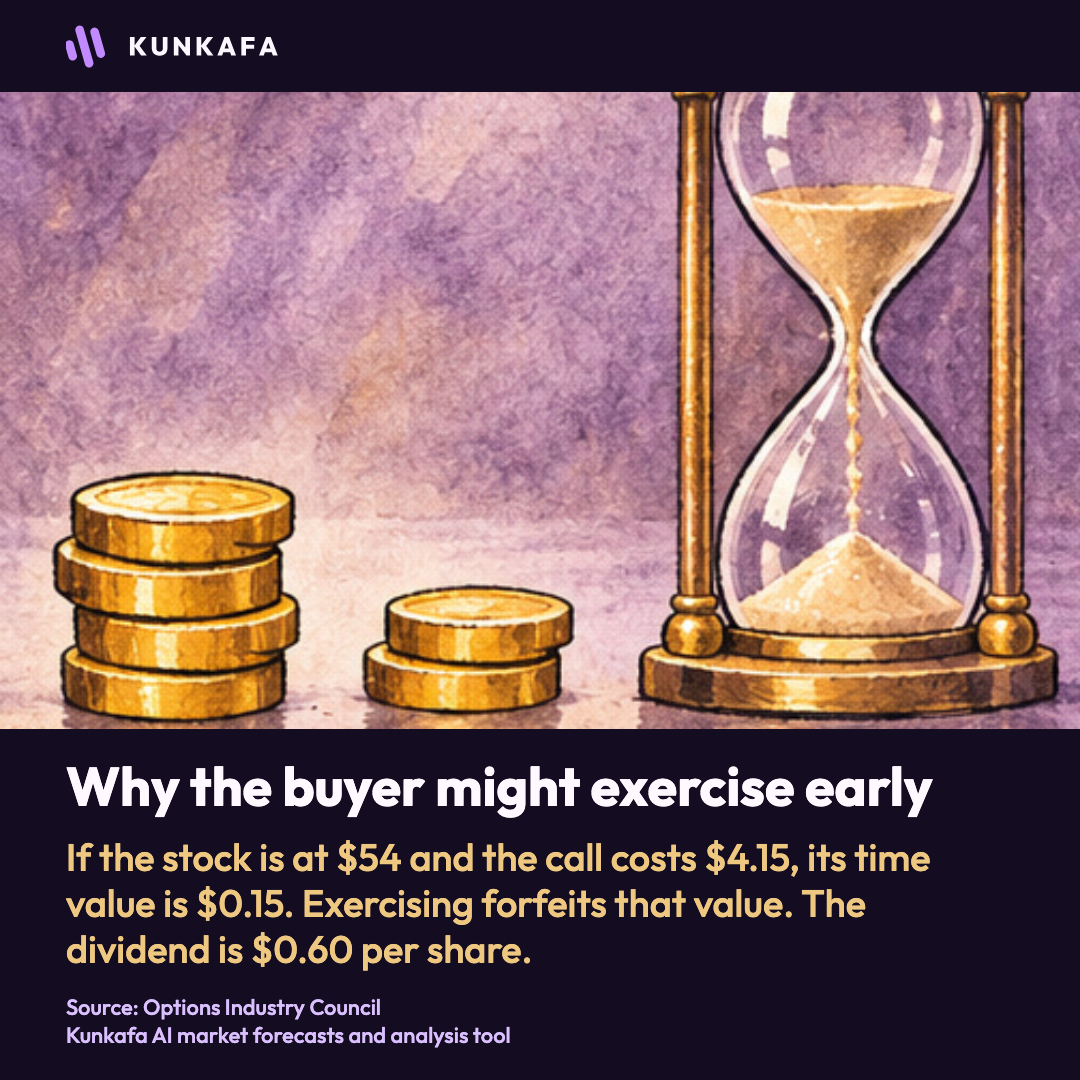
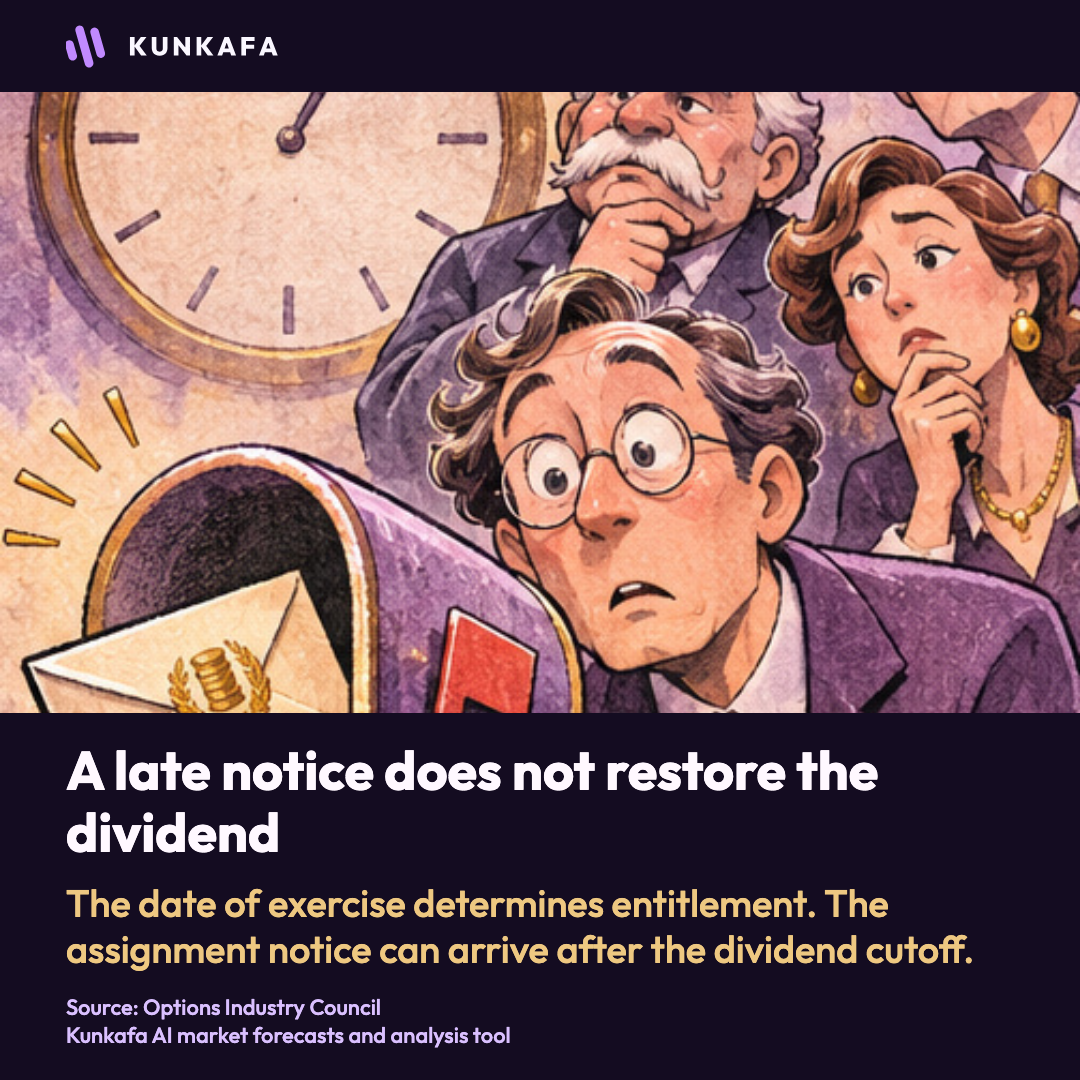

A shareholder who sells an American-style call can miss the stock’s next dividend even if the option expires weeks later. If a call holder exercises before the stock trades ex-dividend and the seller is assigned, the shares pass to the buyer at the strike price. The exercising holder receives the dividend. The seller can learn about the assignment after the ex-dividend date. [1] [2]
Key points
- The premium is earned for writing the option; a dividend depends on entitlement to the shares.
- A call owner may exercise early as the ex-dividend date approaches.
How do the shares and cash change hands?
Take an illustrative call covering 100 shares with a $50 strike. Its seller already owns the shares and collected a $1.20 premium per share, or $120. The company declares a $0.60 dividend, worth $60 on that holding. An early assignment before the relevant ex-date delivers the 100 shares for $5,000. The seller keeps the $120 premium and misses the $60 dividend. The $5,000 is sale proceeds, not profit; the original cost of the shares also matters. [1] [2]
Now suppose the stock trades at $54 and the call at $4.15. Of that option price, $4 is intrinsic value: the right to buy a $54 share for $50. The rest, $0.15, is time value. An owner exercising immediately gives up that remaining time value. A $0.60 dividend is large enough relative to $0.15 to make early exercise worth examining. Costs and the cash needed to buy the shares can change the holder’s choice. [2] [3]
The Capsule
- Check whether the contract allows early exercise.
- Look up the ex-dividend date as well as the option expiry.
- Separate intrinsic value from the remaining time value.
- Keep premium, share-sale proceeds and cash dividend on separate lines.
Can the seller know in advance?
The option holder chooses whether to exercise. A particular writer cannot tell from the market price alone whether an assignment is coming. If the shares stay with the seller through the dividend cutoff, the seller can retain the dividend and still face assignment later. Once an exercise before the cutoff is assigned, a later notification does not restore dividend entitlement. [1] [3]
Sources: [1] Options Industry Council, exercise FAQ · [2] Options Industry Council, covered calls · [3] Options Industry Council, assignment discussion
Kunkafa forecasts
S&P 500 Index
How far it could move, which way, by when, and how confident Kunkafa is.
Check the latest forecastsMore in Markets

How to Compare Two MSCI World ETF Fees in France
Two French disclosures model the same €10,000 over one year. One shows €20 in product costs, the other €38. The five-year column needs a different reading.

US Stocks Close at 1 p.m. New York Time on Black Friday
The day after Thanksgiving cuts three hours from Friday’s regular stock trading session.

Sandisk jumps 13%, Vertex falls 6% in S&P 500 trading
Coherent also gained nearly 12% as storage and optical-component stocks led Friday’s shortened US session. Vertex fell after a delay to its kidney drug review.