Markets · Explainer
Why Higher LNG Prices Can Leave ADNOC Gas Profits Flat
One quarter in Abu Dhabi shows how a rising Asian LNG benchmark can coincide with weaker export volumes and steady group earnings.

Kunkafa News · Published · 3 min read
 By Kareem FaridDiscuss with the author on X
Here is a visual story in summary
Key points
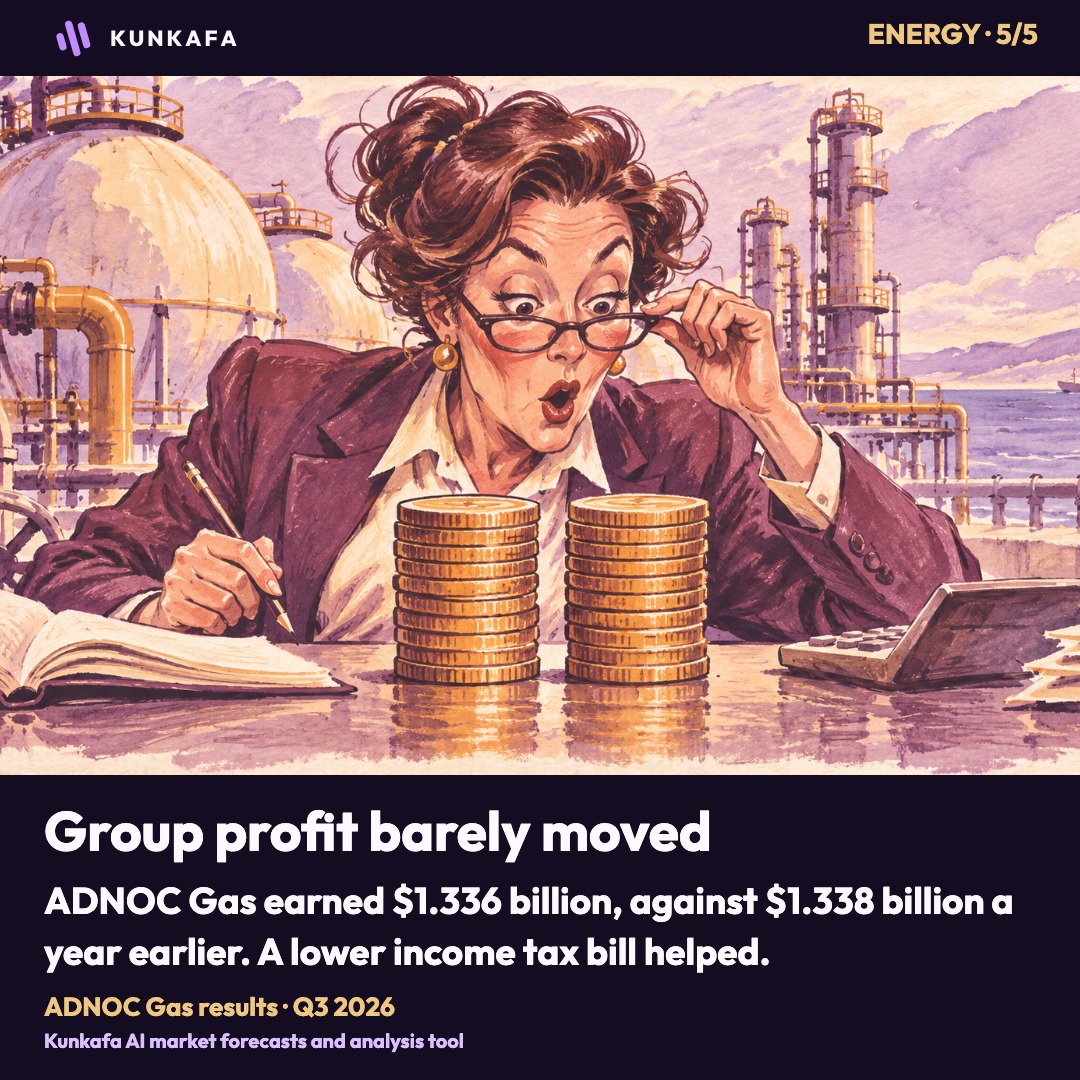
- The Asian LNG marker rose 52% year on year in Q3 2026. ADNOC Gas earned $1.336 billion, close to the previous year’s $1.338 billion.
- Domestic sales, exported liquids and the LNG venture each have different price and volume drivers.
When Asian buyers bid up a cargo of liquefied natural gas, which part of ADNOC Gas benefits? In the third quarter of 2026 the company’s LNG venture earned more from the prices it actually received. Yet the group made almost exactly the same net profit as a year earlier. The gap starts with what leaves the plant by pipeline and what can reach a ship. [1]
Which sales follow Asian LNG prices?
The Japan Korea Marker measures an Asian LNG market price. ADNOC Gas reported that it rose 52% year on year. The company’s share of earnings before interest, taxes, depreciation and amortization (EBITDA) from its LNG venture rose 16% to $204 million. Management attributed the gain to higher realized LNG prices. The presentation counts 70% of the venture’s volumes and includes other products, such as naphtha. Multiplying the Asian price by every unit in that column gives a misleading revenue estimate. [1][2]
Why did the domestic and liquids businesses behave differently?
Domestic gas EBITDA reached $878 million, up 28% on the preceding quarter as seasonal demand lifted sales gas volumes and improved margins. Export and traded liquids EBITDA fell 28% from a year earlier to $701 million. ADNOC Gas cited lower export volumes and weaker realized liquefied petroleum gas prices. LPG includes propane and butane. It is a different product from LNG, which is predominantly methane. [1]
The Capsule
- Match the price to the product and destination before estimating revenue.
- Compare realized prices with actual cargo liftings over the same dates.
- Use the company’s ownership share when reading venture volumes.
- Read cash flow after capital investment separately from EBITDA.
What does a shipping constraint do to the arithmetic?
The company sold 198 trillion British thermal units of export and traded liquids, down from 273 trillion a year earlier. It linked constrained shipments to disruption through the Strait of Hormuz. An expensive international cargo does little for the quarter’s sales if it cannot be loaded. That also helps explain how reported market benchmarks for propane and butane could rise even as management cited weaker realized LPG prices. The report gives no universal formula for translating a benchmark move into a customer invoice. [1]
Group EBITDA was $2.027 billion. Net profit was $1.336 billion, helped by lower income tax expense. After funding projects, the company reported $539 million of free cash flow for the quarter on its measure excluding working-capital movements. Those are three different answers to three questions about operating earnings, shareholders’ profit and cash left after investment. [1]
Sources: [1] ADNOC Gas Q3 2026 management discussion · [2] ADNOC Gas Q3 results presentation.
Kunkafa forecasts
Brent oil
How far it could move, which way, by when, and how confident Kunkafa is.
Check the latest forecastsMore in Markets

DIB Deal Would Create a $159 Billion Islamic Banking Group
Dubai Islamic Bank signed for 100% of Emirates Islamic. Seller Emirates NBD would receive newly issued DIB shares and become a strategic shareholder.

HP Rises 8% as Five S&P 500 Stocks Drop More Than 10%
HP’s earnings beat made it the clear winner after the bell. All five of the steepest declines hit companies that supply the computing buildout.

Fed Hike Odds Hit 99.8% for December. Is January Next?
After GDP and inflation beat estimates, traders priced a quarter-point rise and put 59.5% odds on another step by January. Proposed tariffs add a risk for 2027.